- 18.06.2026 - 09:22
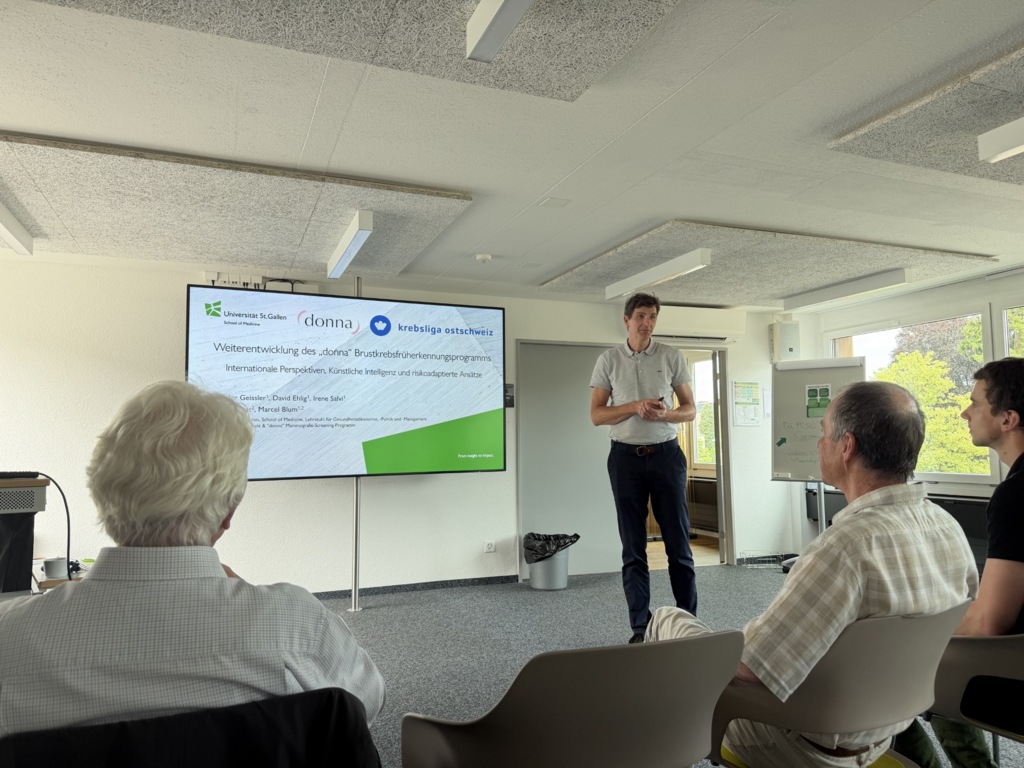
Prof. Dr. Alexander Geissler opened the session with a review of the research collaboration that has been underway since 2023. Two publications stood out: one on the potential of AI to reduce interval cancers, and another on the survival advantage of program participants compared to women whose tumors were detected outside the program.
Dr. Irene Salvi presented findings from the first two expert panels. The consensus: The 50–74 age group and the two-year screening interval should remain in place for the time being, but risk-based intervals are considered an important direction for future development. Regarding the use of AI, there was agreement that AI must meet the same quality requirements as human readers and that the lack of a regulatory framework currently represents the biggest hurdle.
Marcel Blum presented initial results comparing two AI algorithms using a “donna” dataset. Conclusion: Both AI algorithms can improve the effectiveness and cost-efficiency of screening programs when used as triage tools or second readers.
Dr. Rudolf Morant used the WISDOM study to demonstrate that risk-based screening is not inferior to annual mammography (as is standard in the U.S.). The general direction is clear: organized mammography screening as the foundation, supplemented by risk- and density-based additional diagnostics as well as carefully regulated use of AI.
In closing, Dr. David Ehlig provided an overview of the research priorities for the current year. On the one hand, the project The Future of Breast Cancer Screening in Switzerland is entering its final phase; on the other hand, additional projects—including the MAIA (Mammography & Artificial Intelligence Assessment) project and the PinkCube project—were launched this spring.
The collaborating partners would like to thank all participants for their active involvement, the lively discussion, and the personal exchanges during the closing reception. Many research questions remain unanswered—the collaboration between MED-HSG and the Krebsliga Ostschweiz will continue to work on these in the coming years to provide evidence-based answers and further develop breast cancer screening in Switzerland.
The presentation slides can be found here:  20260617_HSG_Krebsliga_Presentation.pdf