- 19.10.2026 - 15:31
Key Message
National hospital reforms can be harmonized in federal health care systems even without statutory requirements: The Zurich model of hospital planning service groups (SPLG) has been voluntarily adopted by nearly all cantons. However, significant differences remain regarding politically sensitive requirements, particularly with regard to minimum case volumes.
Background
With the revision of the Health Insurance Act (KVG) in 2012, Switzerland introduced, among other things, a national hospital planning reform. Planning was to be reoriented toward services, demand, and quality rather than bed capacity. Implementation, however, was left to the 26 cantons, which define the specific requirements themselves. The Chair of Health Economics, Policy, and Management at the University of St. Gallen is examining how the cantons have implemented the reform and which factors explain the observed differences.
Methodology
The study combines three approaches. First, a document analysis of all cantonal hospital lists and requirements catalogs through June 2025, which were compared line by line with the corresponding Zurich catalog. Second, 25 semi-structured interviews with representatives from 20 cantons as well as with national experts. Third, an exploratory k-means cluster analysis that examines whether cantons with similar structures (e.g., in terms of degree of urbanization, age structure, and hospitalization rate) deviate from the Zurich guidelines to a similar extent. The Health Policy Triangle served as the analytical framework.
Results
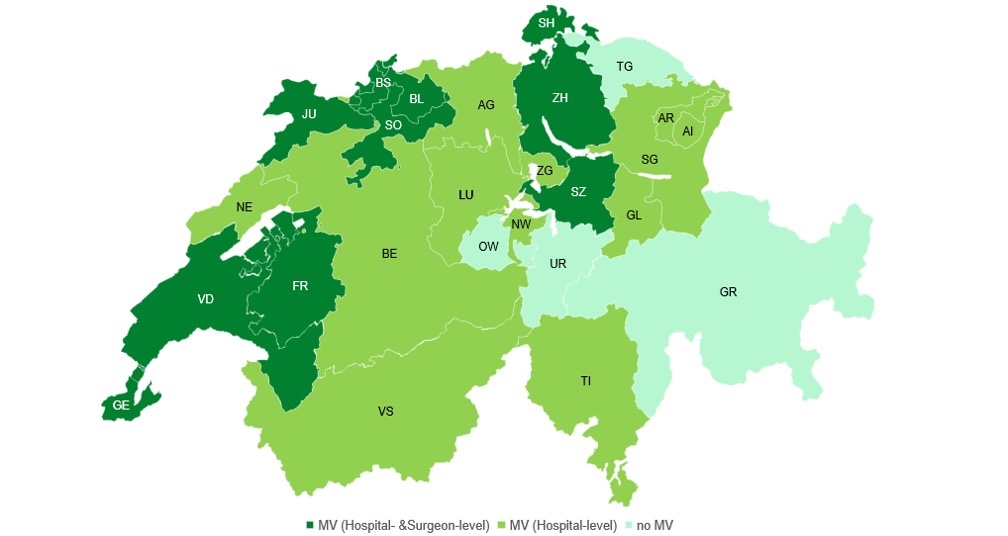
By 2024, 25 of 26 cantons had adopted the SPLG method. Twelve cantons, along with Zurich, adopted it as early as 2012, while Vaud was the last canton to follow suit in 2024. French-speaking cantons tended to adopt the model later. Differences in the number and definition of service groups, as well as in most quality requirements, are minor and often stem from the fact that cantons use older versions developed in Zurich. The minimum case numbers, however, differ significantly: Ten cantons apply them at the hospital and surgeon levels, eleven only at the hospital level, and five not at all. The threshold values also vary widely. For spinal surgery, for example, the threshold in Zurich is 100 cases per hospital, while in Bern it is 10. These discrepancies are not based on doubts about the correlation between case volume and treatment quality, which 18 of 22 cantons—as well as all experts surveyed—confirm. Rather, the decisive factors are political feasibility, access issues in mountainous regions, and concerns about financially destabilizing regional hospitals. The cluster analysis shows that easily observable structural characteristics alone do not explain the extent of the variations.
Implications for Practice and Policy
The study distinguishes between two forms of divergence. Passive divergence arises from limited administrative resources, particularly in smaller cantons. Active divergence, by contrast, is politically motivated. A central agency that defines and maintains service categories and quality requirements at the national level could reduce passive divergence, lower the administrative burden on smaller cantons, and strengthen intercantonal planning. At the same time, the cantons should retain leeway for regional adjustments. However, this leeway should be tied to transparent rules within a defined framework and accompanied by systematic impact analyses on access, quality, and costs. The findings are also relevant for other federal systems.
Publication
Title: What drives regional variation in hospital reform implementation? Insights from more than a decade of Swiss hospital planning
Authors: Carla Walker, Charlotte Lang, Daria Bukanova-Berend, Katharina Lonnes, David Ehlig, Justus Vogel, and Alexander Geissler
Published in: Health Policy OPEN
You can read the full study here: HERE